
Growing up, Fredrick Dennis and his siblings didn’t have it easy.
His father wasn’t around. His stepfather was physically abusive, and often beat Fredrick and his brothers, despite their mother’s best attempts to intervene. And once Fredrick’s stepfather introduced his mother to heroin, stability became hard – sometimes impossible – to come by.
Surrounded by addiction and violence, Fredrick didn’t have much in his life that made him feel safe, seen, or like he had a future. Then he learned to box.

A community church paid the $10 monthly fee for 12-year-old Fredrick’s boxing lessons – a fee he never would have been able to afford on his own. He started boxing regularly after school, channeling his frustration and rising quickly from beginner to stand-out talent.
Fredrick didn’t just fall in love with boxing – he was great at it. By the time he was 14, Fredrick was a champion boxer ranked 4th in the country.
But in the face of trauma, still lacking the stability he desperately needed at home, Fredrick struggled to see his 4th place ranking as a success. The sting of not taking first place sent him reeling and, like so many young people before him, he started looking for belonging and validation in a place he was sure he could find it: he joined a local gang.
By the time he was 15, Fredrick was in jail.

That’s when his mother called lawyer and director of Lawndale Christian Legal Center (LCLC), Cliff Nellis, to ask for help.
Fredrick missed his first few years of high school while LCLC worked to get him released. When a jury found him not guilty at the age of 17, he was freed to return home to his mother, who was now sober, and start over.
But incarceration didn’t address or heal the trauma, instability, and lack of support that Fredrick had experienced in the early years of his life.
Being locked up hadn’t addressed the root causes of Fredrick’s choices. As a result, in a few short years, he was arrested again.
But this time, something different happened. Something better.
Instead of jail time, Fredrick moved into The MAC House, a residential workforce development program run by LCLC.

“At the MAC House, I would tell myself ‘You’ve got yourself in a good place.’” Fredrick remembers. “I didn’t have to worry – I had a place that was mine. I got a job. I could help my mom pay her bills, help take care of my little brothers. It changed the way I felt about myself. I learned how to be responsible.”
As an alternative to spending eight years incarcerated, Fredrick received secure housing, education, mental health care, employment support, and community at the MAC House. He secured employment with a local union and made the prevailing wage. If Fredrick had gone to prison, he’d have come out with a permanent record and a strong probability of being arrested again (there’s a 55%* recidivism rate for emerging adults in Illinois).

Instead, today Fredrick is married with children. He has a great job and owns his home. And he now works on staff with LCLC to help more young people like him move through, and away from, the justice system.
When young people get entangled with the criminal justice system and are sentenced to prison time, it can ruin their lives.
But there’s a better way.
The MAC House, where Fredrick lived, was a pilot program started by LCLC, providing five emerging adults with the safety and support they needed to learn, grow, and thrive. The outcomes for the participants of this pilot were impressive: four of the five MAC House participants landed union wage jobs and one landed a non-union laborer job. All five stayed out of the criminal justice system.
Inspired by the success of the MAC House, LCLC is now opening the Dr. Dennis Deer Community Justice Center.
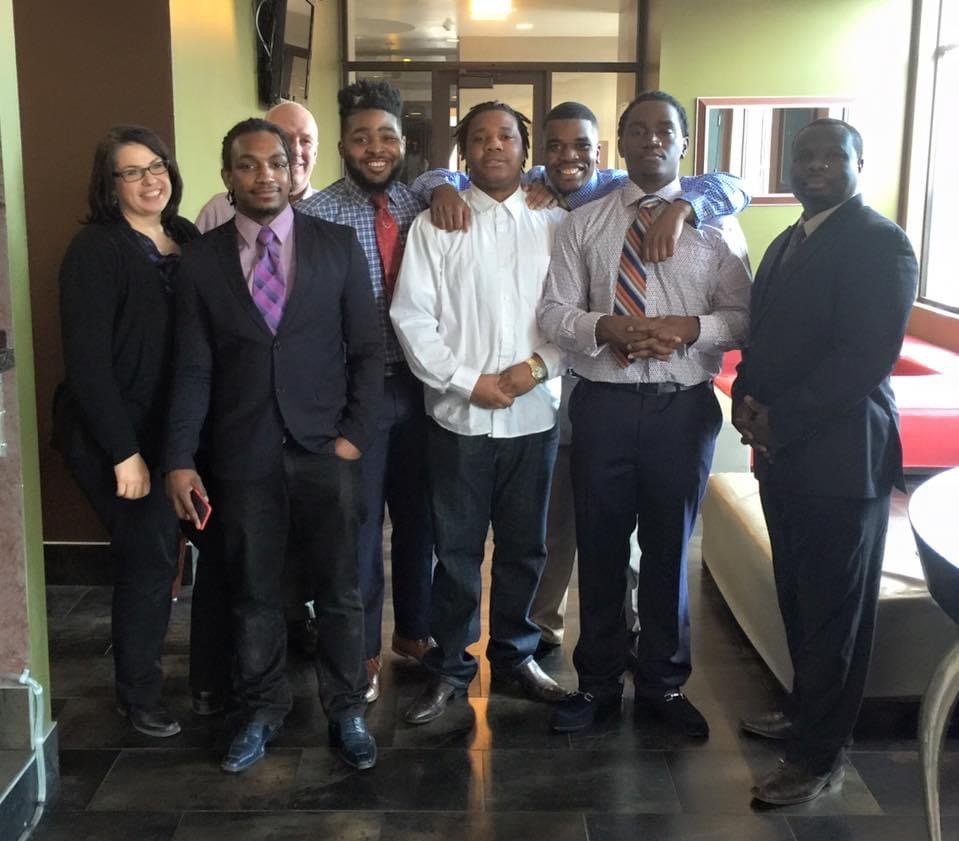
The Deer Center will house 20 young men at a time, ages 18-25, as an alternative to incarceration and surround them with safety, education, job training, employment, legal support, mental health care, and mentorship.
For young adults like Fredrick, the Deer Center provides a clearly better option, a solution that both transforms lives and saves the system hundreds of thousands of dollars.
Using Fredrick’s experience as an example, here are the projected cost breakdowns of the two different paths – incarceration for 8 years, versus the community-based residential workforce development alternative offered in the Deer Center:
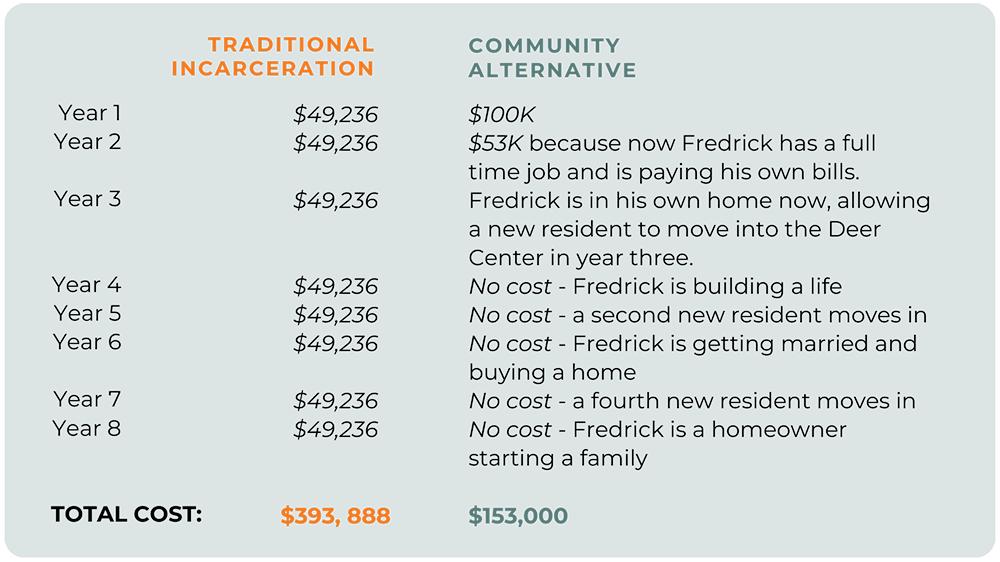
In the corporate world, we all know the importance of figuring out your “return on investment” or ROI. Based on the MAC House pilot, you can see an ROI that includes both positive human outcomes as well as positive financial results.
Unlike the total cost for the traditional incarceration approach of $393,888, the initial higher upfront investment of $153,000 in the residential workforce development alternative, is ultimately a smarter one financially.
The overall outcome on investment in human terms – looking at the example of Fredrick – not only yielded good financial ROI, it yielded marriage, parenting children, full-time employment, financial independence, long-term stability, and freedom from the criminal justice system. Compared to the lengthy incarceration, permanent record, and 55% chance of recidivism for those that went to prison, the outcome of the community-based alternative is decidedly preferable.
The Dr. Dennis Deer Community Justice Center is just the beginning.
We want to make sure more young people have the option of a supportive, restorative residential workforce development alternative to incarceration, just like Fredrick.
We’re confident that if we build more places like the Deer Center, we can improve the way we take care of justice-involved youth in our communities, our cities, and our country as a whole.
But we can’t do it without you.
To learn more about how you can get involved, support programs like the Deer Center, and help us make sure more young people like Fredrick have the opportunity to experience the safety and stability they deserve:

